
Watch presentation before you make choices – Click here
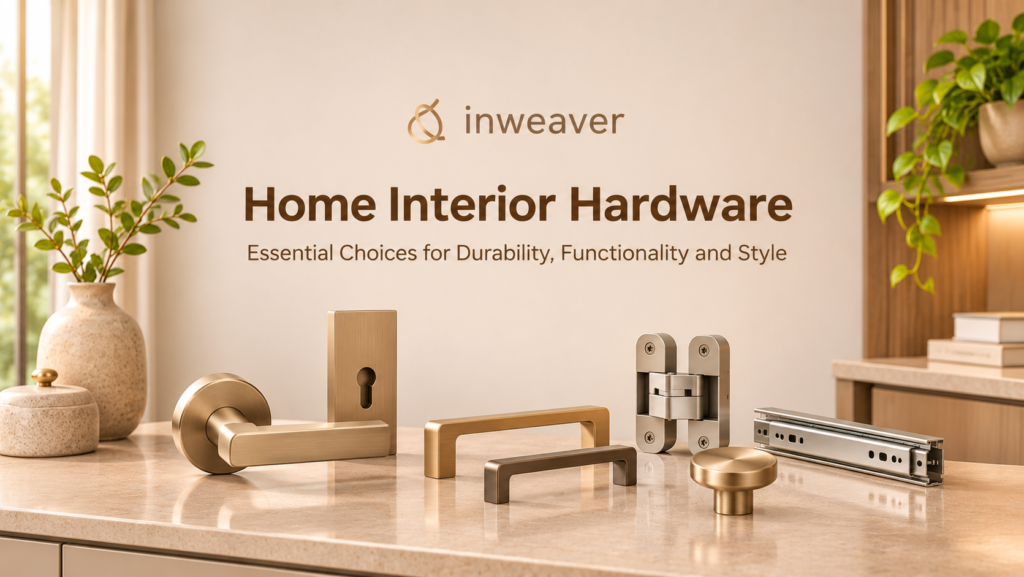
A homeowner’s guide to furniture fittings, leading brands, quality, costs and choosing the right hardware for your home.
Beautiful interiors are not just about what you see. They are also about how everything works.
Imagine a kitchen drawer that glides effortlessly, a wardrobe shutter that closes softly without a sound, or an overhead cabinet that opens with a gentle touch. These everyday conveniences are made possible by something that rarely gets attention during interior design discussions: furniture hardware.
While homeowners spend considerable time choosing colours, finishes, materials and furniture styles, hardware often remains an afterthought.
Yet the quality of hardware determines how smoothly your cabinets operate, how conveniently you access storage, and how well your furniture performs over the years.
Understanding a few basics about hardware can help you make better decisions and avoid unnecessary expenditure.
Home interior hardware refers to the mechanical fittings, accessories and functional systems that make furniture usable.
From the hinges that support cabinet shutters to the mechanisms that allow kitchen drawers to open and close, hardware is the engineering behind functional interiors.
It broadly includes:
Cabinet and drawer mechanisms: Hinges, sliding channels, drawer systems and soft-close fittings.
Kitchen storage solutions: Pull-out storage, corner mechanisms, pantry systems and organisers.
Lift-up and specialised opening systems: Mechanisms for overhead cabinets and unconventional shutters.
Wardrobe and furniture fittings: Sliding door systems, internal wardrobe accessories and space-saving mechanisms.
Decorative and functional accessories: Handles, knobs, profiles, locks and selected automation solutions.
The range has expanded considerably over the years. Modern furniture hardware can now offer concealed mechanisms, push-to-open convenience, sophisticated movement control and even electrically operated systems.
The important question is not whether you need the most expensive hardware, but which hardware provides the right combination of functionality, durability and value for your home.
Hardware is among the most frequently operated components of home interiors.
Consider the number of times a kitchen drawer, cabinet shutter or wardrobe is opened and closed over ten or fifteen years. Even small differences in the quality of these mechanisms can become significant over time.
Good-quality hardware contributes to:
Smooth and comfortable operation. Drawers glide without excessive effort, shutters open predictably, and soft-close mechanisms prevent unnecessary slamming.
Durability and reliability. Properly selected fittings are designed to carry specified loads and withstand repeated operation.
Better use of available space. Well-designed storage mechanisms can make deep cabinets, corners and overhead spaces easier to access.
Improved aesthetics. Concealed runners, slim drawer sides and discreet opening mechanisms can support cleaner, more contemporary furniture designs.
Long-term value. Reliable hardware, installed correctly and used within its specifications, can reduce avoidable repairs and replacements.
However, premium hardware alone cannot guarantee good performance. Correct specifications, cabinet dimensions, installation and adjustment are equally important.
India has access to both established domestic manufacturers and internationally recognised furniture-hardware specialists.
Some brands offer a comprehensive range of furniture fittings and accessories, while others focus on specialised movement systems and precision engineering.
Here are six important brands worth understanding.
Origin: India
Ebco is an established Indian furniture-hardware manufacturer offering solutions across furniture fittings, drawer mechanisms, kitchen storage, wardrobes and accessories.
Its broad product range and value-oriented positioning make it relevant for budget and mid-range residential projects. Certain higher-specification Ebco ranges can also be considered for premium homes.
Best suited to: Budget and Premium homes where functionality and expenditure must be carefully balanced.
Origin: Germany
Häfele offers an extensive range of furniture fittings, architectural hardware, kitchen storage solutions and interior accessories.
One of its strengths is the breadth of solutions available across different parts of a home. This makes it convenient for projects requiring several categories of hardware and coordinated specifications.
Best suited to: Premium and Luxury homes, with selected solutions for budget-conscious projects.
Origin: Germany
Hettich is a globally established furniture-fittings manufacturer recognised for its cabinet hinges, drawer systems, runners and furniture movement solutions.
Its portfolio spans practical standard fittings as well as sophisticated premium systems.
This range allows designers to select products according to the intended furniture application rather than specifying one quality level throughout the home.
Best suited to: Premium and Luxury homes, as well as selected Budget and Ultra-Luxury applications.
Origin: Austria
Blum specialises in furniture movement systems, including hinges, drawer systems, runners and advanced cabinet-opening mechanisms.
Its solutions place significant emphasis on smooth operation, controlled movement, convenience and refined furniture integration.
Blum is particularly relevant when the quality of movement and daily user experience are important design priorities.
Best suited to: Premium, Luxury and Ultra-Luxury homes.
Origin: Austria
GRASS is another established international specialist in furniture movement technology, with a strong focus on drawers, runners, hinges and opening mechanisms.
Its advanced drawer and movement solutions are suited to sophisticated kitchens, wardrobes and contemporary furniture designs.
Best suited to: Luxury and Ultra-Luxury homes.
Origin: Italy
Salice is known for concealed hinges, drawer runners, lift mechanisms and sophisticated sliding and pocket-door systems.
Its product portfolio is particularly relevant to specialised furniture applications where minimal visible hardware and unusual opening arrangements are part of the design intent.
Best suited to: Luxury and Ultra-Luxury homes, especially where specialised mechanisms are required.
| Brand | Broad product coverage | Principal strength | Typical residential positioning |
|---|---|---|---|
| Ebco | Broad | Value-oriented functional hardware and accessories | Budget–Premium |
| Häfele | Very broad | Complete interior hardware and storage solutions | Premium–Luxury |
| Hettich | Broad | Precision fittings, drawer systems and movement technology | Premium–Luxury |
| Blum | Specialised | Advanced drawer, hinge and lift systems | Premium–Ultra-Luxury |
| GRASS | Specialised | High-end furniture movement technology | Luxury–Ultra-Luxury |
| Salice | Specialised | Concealed and sophisticated opening systems | Luxury–Ultra-Luxury |
These are general market-positioning descriptions, not absolute quality rankings. Most leading brands offer multiple product families at different price points.
A useful distinction is that a comprehensive hardware supplier may offer a wider selection of kitchen and wardrobe accessories, while a specialised manufacturer may focus more deeply on how furniture shutters and drawers move.
There is no universal winner across every application.
The appropriate hardware depends on the intended level of comfort, usage, sophistication and overall project budget.
The emphasis should be on dependable functionality, practical storage and sensible expenditure.
Quality standard mechanisms, durable basic fittings and selective use of soft-close systems can offer good value.
Typical brand consideration: Ebco, along with suitable entry-level ranges from other established manufacturers.
The objective should be dependable everyday operation rather than investing in sophisticated mechanisms that offer limited practical benefit.
Premium interiors benefit from greater attention to the experience of using furniture.
Soft-close mechanisms, smooth drawer movement, better storage access and well-finished hardware become more important.
Typical brand consideration: Hettich, Häfele, selected Blum ranges and higher-specification Ebco products.
This is often the segment where carefully chosen upgrades can make a noticeable difference without disproportionately increasing the overall interior cost.
Luxury interiors demand greater integration between furniture design and the hardware that supports it.
Advanced drawer systems, concealed mechanisms, sophisticated cabinet openings and high-quality finishes can contribute to a more refined experience.
Typical brand consideration: Blum, Hettich, Häfele, GRASS and Salice.
At this level, hardware selection should be closely integrated with furniture detailing and the design specifications.
Ultra-luxury interiors may incorporate large or unusual furniture panels, automated opening systems, specialised pocket doors, highly integrated storage and custom-designed mechanisms.
Typical brand consideration: Premium specialist ranges from Blum, GRASS, Salice, Hettich and Häfele, depending on the application.
Here, the priority shifts from simply selecting a premium brand to achieving the desired architectural and functional experience.
Importantly, an Ultra-Luxury home does not require the most expensive fitting in every cabinet. Some applications benefit from advanced technology, while others perform perfectly well with simpler, reliable mechanisms.
Hardware costs can vary considerably between manufacturers, product families and specifications.
Comparing two brands without considering the type of mechanism, load capacity, features and included components can be misleading.
Nevertheless, a broad price-positioning index can help homeowners understand the possible difference in expenditure.
Taking Ebco as the base at 100% (1.0×):
| Brand | Indicative relative price | Approximate price premium |
|---|---|---|
| Ebco | 1.0× | Base — 0% |
| Hettich | 1.2–2.0× | +20% to +100% |
| Häfele | 1.5–2.5× | +50% to +150% |
| Blum | 2.5–5.0× | +150% to +400% |
| GRASS | 2.5–6.0× | +150% to +500% |
| Salice | Quotation-dependent | Depends on specialised application |
How to interpret this table: These figures are broad, illustrative budget-planning allowances informed by selected hardware listings and product ranges, not verified brand-wide price averages or guaranteed like-for-like comparisons. Entry-level and premium products within the same brand can have very different prices. Some specialist systems have no direct equivalent in other brands.
For an actual purchase decision, compare complete product configurations with similar functionality, load rating, dimensions and features.
Also, a price premium on an individual mechanism does not translate into the same percentage increase in the cost of an entire kitchen or home interior project.
A well-planned hardware budget is about investing more in fittings that genuinely improve everyday use.
Not necessarily.
There is no technical requirement to use one manufacturer for every furniture component.
A carefully designed home may use premium movement systems in frequently used kitchen drawers, reliable standard mechanisms in secondary storage, and specialised hardware for a few distinctive furniture applications.
This allows investment to follow function and importance rather than brand preference alone.
However, components within a particular drawer or cabinet system must be compatible. Combining unrelated mechanisms without technical verification can lead to performance and installation problems.
A good design specification should therefore identify the required function, performance and product compatibility before selecting the manufacturer.
When reviewing an interior design proposal or contractor quotation, it is useful to ask a few simple questions:
Is the exact brand and product range specified? The brand name alone may not indicate the quality or price of the proposed fitting.
What features are included? For example, soft-close, push-to-open, opening angle or storage accessibility.
Is the fitting suitable for the intended load and size? Hardware must be compatible with the dimensions and weight of the furniture.
Does the quotation include the complete mechanism? Individual components, complete sets and installed systems can have very different prices.
What warranty and service support are available? Check manufacturer conditions, local availability and the ease of obtaining replacement components.
Transparent specifications help homeowners make informed comparisons between proposals and reduce the risk of unintended substitutions during execution.
If you would like to learn more about the available technologies and product families, these official manufacturer resources are useful starting points.
| Brand | Official website | Product catalogue / resources |
|---|---|---|
| Ebco | ebco.in | Ebco Downloads |
| Häfele | Häfele India | Furniture Fittings Catalogue |
| Hettich | Hettich India | Hettich Downloads |
| Blum | Blum India | Blum Product World |
| GRASS | grass.eu | GRASS Product Catalogues |
| Salice | salice.com | Salice Catalogues |
These resources are particularly useful when exploring new technologies, confirming specifications and identifying suitable product families. Actual availability and pricing in India should be checked with authorised suppliers.
At Inweaver, we believe that good home interiors begin with a clear design intent.
Furniture hardware should not be chosen independently of the furniture design, lifestyle requirements and available budget.
The right selection depends on how often a cabinet is used, what it needs to store, how accessible it should be, and how the furniture contributes to the overall design.
A premium mechanism may be a worthwhile investment in one location and unnecessary in another.
By considering these requirements during planning and design, homeowners can arrive at more thoughtful specifications and transparent budgets.
The objective is not to select the most expensive hardware. It is to select the right hardware for the right application.
This principle applies equally to modest homes and sophisticated luxury residences.
Plan & Design Before Build.
Explore Inweaver’s home interior planning and design tools at app.inweaver.com.
Disclaimer: Brand positioning and indicative price comparisons are provided for general homeowner education, based on selected market references reviewed in November 2026. They do not constitute manufacturer rankings, formal quotations or recommendations for specific installations. Product availability, configurations, pricing and warranties are subject to change. Brand names belong to their respective owners, and their inclusion does not imply endorsement of or affiliation with Inweaver.

Inweaver Technologies Pvt. Ltd,
5B, 2nd Floor, 10th Cross, RMV Extension, Sadhashivanagar,
Bangalore 560080. India
support@inweaver.com
Phone +91 63633 87505