
Watch presentation before you make choices – Click here
Understanding wood, plywood, engineered boards, aluminium, uPVC, glass and other common base materials used in home interiors
When homeowners think about interiors, they usually focus on what is visible — colours, finishes, styles, lighting and furniture.
But beneath every good-looking wardrobe, kitchen, TV unit, loft, partition or window system lies an important foundation: the base material.
The choice of base material affects not just appearance, but also strength, durability, maintenance, moisture resistance, longevity, budget and performance.
A beautiful finish applied on the wrong base material may not last well.
A carefully selected base material, on the other hand, can make interiors more reliable, more functional and more cost-effective in the long run.
At Inweaver, we believe homeowners should understand these basics before finalising designs, budgets and specifications.
Base materials are the structural materials used to make furniture, shutters, cabinets, partitions, doors, frames, windows and other interior elements.
These materials form the body or skeleton of the interior component. Finishes such as laminate, veneer, paint, acrylic, membrane or polish are then applied over them, depending on the design intent.
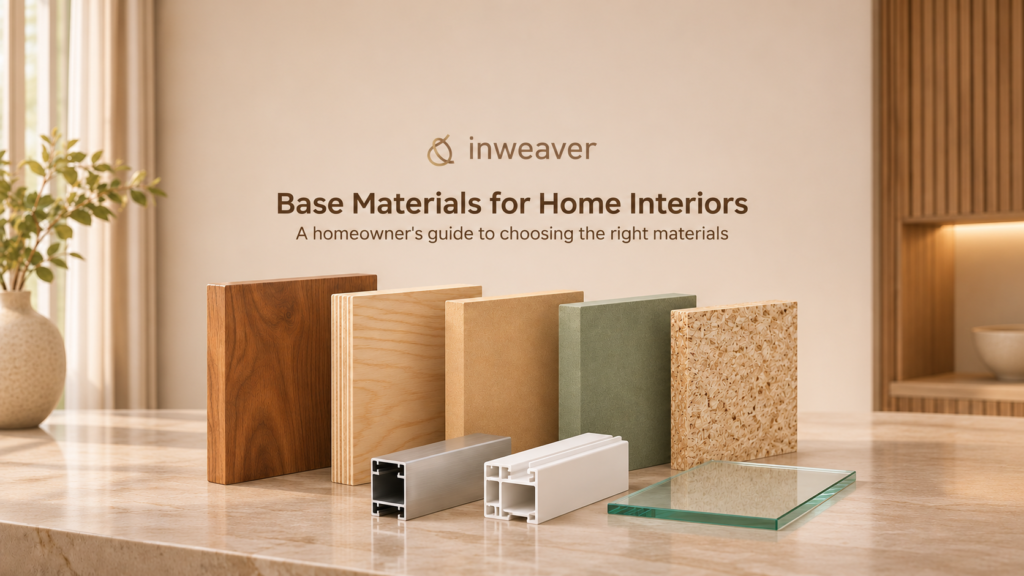
Common base materials used in home interiors include:
Each of these materials has its own strengths, limitations and ideal applications.
The choice of material is not just a technical issue. It directly affects daily life and long-term value.
A wardrobe in a dry bedroom and a cabinet near a sink do not face the same conditions.
A window frame has very different performance requirements compared to a decorative wall panel.
A child’s study table, a modular kitchen carcass and a glass partition all demand different types of materials.
Material choice influences:
How long the furniture or element lasts under regular use.
How well the material performs in kitchens, utility areas, bathrooms or humid climates.
Whether the material can handle shelves, shutters, countertops or hanging units properly.
How well laminates, veneers, paint or other finishes sit on the material.
Whether the material is easy to clean, repair and maintain.
Some materials are budget-friendly, while others are premium or luxury choices.
Certain materials support sleek modern designs; others are better for warmth, richness or natural character.
The goal is not to choose the most expensive material everywhere, but to choose the right material for the right application.
| Material | Strength | Moisture resistance | Finish flexibility | Cost level | Best use |
|---|---|---|---|---|---|
| Solid Wood | High | Moderate | Natural/polish/veneer | Premium–Luxury | Premium furniture |
| Plywood | High | Good with correct grade | Excellent | Budget–Luxury | General interior furniture |
| Blockboard | Moderate to High | Moderate | Good | Budget–Premium | Doors, partitions, select furniture |
| MDF | Moderate | Low to Moderate | Excellent for paint | Budget–Premium | Decorative panels and painted shutters |
| HDHMR | Moderate to High | Better than MDF | Very good | Premium | Premium shutters and modular units |
| Particle Board | Low to Moderate | Low | Good for laminates | Budget | Cost-sensitive furniture |
| Aluminium | High for framed systems | High | Good | Premium–Luxury | Frames, shutters, partitions |
| uPVC | Moderate | High | Limited compared to others | Budget–Premium | Windows and doors |
| Glass | Application-dependent | High | Elegant but specialised | Premium–Luxury | Partitions, shutters, visual openness |
For budget interiors, material choice should focus on practicality and essential durability.
Suitable materials often include:
The key is to use lower-cost materials carefully and not apply them in high-risk areas without understanding their limitations.
Premium homes usually benefit from better materials and more thoughtful material combinations.
Suitable materials often include:
This is often the best segment for balancing cost, aesthetics and long-term usability.
Luxury homes demand stronger design integration, longer life and higher-quality detailing.
Suitable materials often include:
Ultra-luxury homes may use a richer mix of materials, chosen not only for performance but also for design expression and custom detailing.
Suitable materials often include:
Again, ultra-luxury does not mean using the most expensive material everywhere. It means using each material intelligently for performance and design impact.
Before approving an interior proposal, homeowners should check:
What exactly is the base material?
Terms like “engineered wood” are too broad unless the actual board type is specified.
Is the material suitable for that application?
A dry-area wardrobe and a sink-side kitchen unit may need different solutions.
What finish is going on top?
The finish and the base material must work well together.
How exposed is the area to moisture, heat or heavy use?
Kitchens, bathrooms and utility areas need more careful specifications.
Is the design intent aligned with the material?
Some materials are chosen for warmth, some for sleekness, some for economy and some for durability.
At Inweaver, we believe materials should be selected as part of a larger design process — not as isolated line items in a quotation.
A homeowner first needs clarity on:
Only then can materials be chosen sensibly.
The right material specification helps avoid two common mistakes:
The best interiors are not built by choosing the costliest material everywhere.
They are built by choosing the right material, in the right place, for the right reason

Inweaver Technologies Pvt. Ltd,
5B, 2nd Floor, 10th Cross, RMV Extension, Sadhashivanagar,
Bangalore 560080. India
support@inweaver.com
Phone +91 63633 87505